CESAR AGUIRRE ON TV

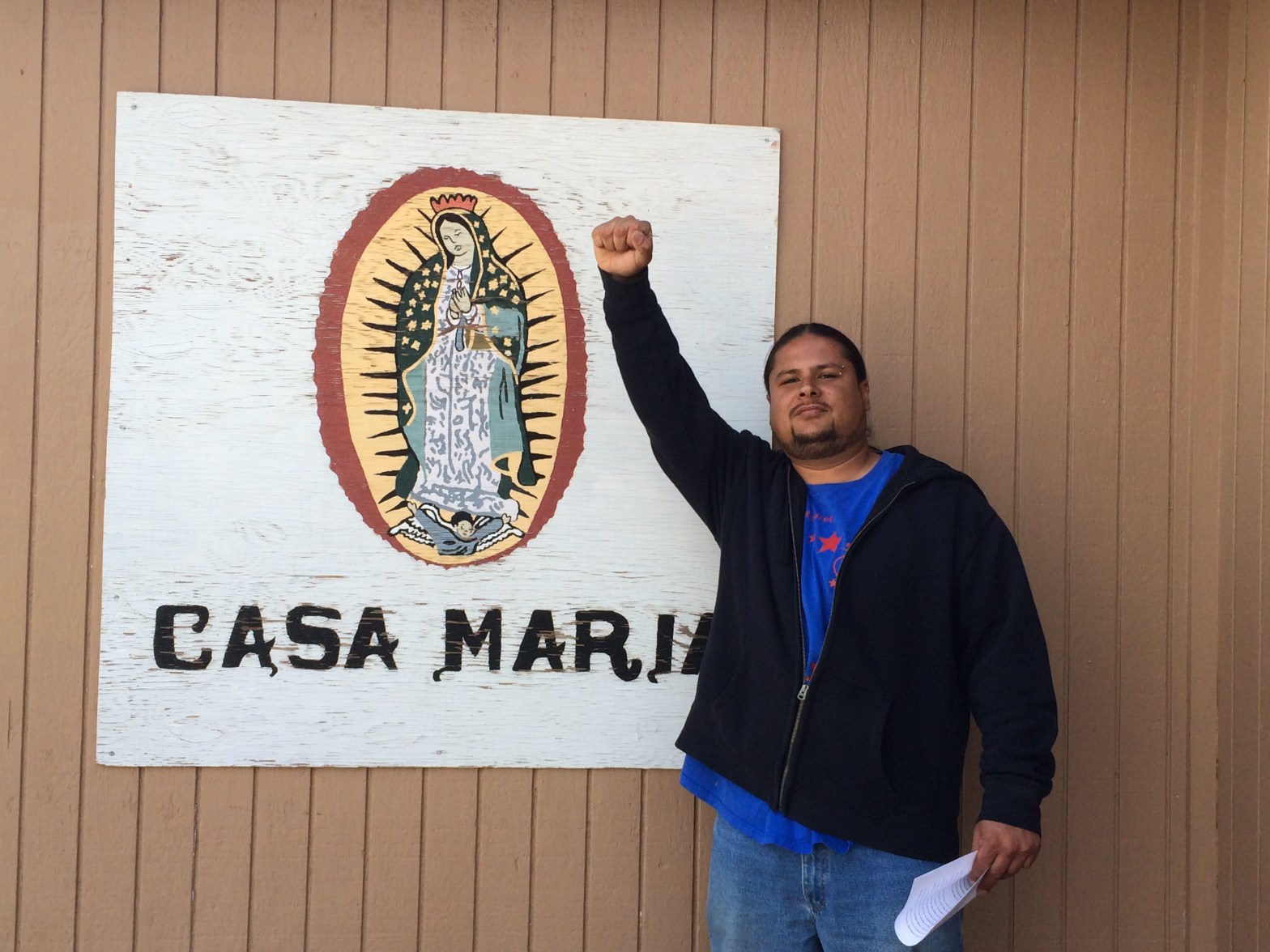
Watch conscious rap artist Cesar Aguirre, single father of two and the pride of Casa Maria, on AZ Illustrated on channel 6 Wednesday night, February 5th at 6:30. He’s going to talk about poverty along with former mayor Tom Volgy.

This is his story.

by Cesar Aguirre

As a child growing up on Tucson’s south side I never realized how poverty would affect my future and life as an adult. I was very lucky to live in a two parent household. Many of the kids in my neighborhood were being raised by single parents or grandparents. I can remember overhearing my parents stressing, trying to figure out how to pay the bills. Even thought my dad was a welder and a fence installation foreman he was not able to provide for our family of five with his income alone. He worked a lot of overtime and did side jobs for extra income. My mom also worked part time at convenience stores until she was able to get her foot in the door at a doctor’s office as a secretary. Both of my parents worked very hard to provide a better future for us and to lift us out of poverty. In doing so they also lost touch with my two siblings and me. We live in a consumer cultured society, so no matter how well my parents did financially it never seemed to be enough.

When I was about 10 years old we moved to the east-central part of town, away from my friends and family. The kids at my new school were very different. They looked different, talked different and dressed different. They teased me because I could not afford brand name clothes. They would gang up and chase my brother and me home from school. Once a group of kids caught up to me while I was riding my bike and knocked me off of it. They beat me up and bent my bike so I could not ride it home. That was when my parents decided to move us to Three Points. I fit in much better there and made friends quickly, the wrong kind of friends. My parents were always working so it was easy for me to hide things from them. By 12 years old I was involved with gangs and drinking alcohol, smoking marijuana by 13 and experimenting with hard drugs by 14. By the time I was 16 years old I was working part time and selling drugs full time. Easy money was very attractive to me because growing up seeing my dad work himself to the bone I knew that no matter how hard I worked I could never earn enough money to have the things I wanted. Never again did I want to feel like I did when I was living on the east-central side of town.

My oldest daughter was born when I was 21 years old and at that moment, like a bolt of lightning, it hit me that what I was doing was wrong. I wanted to be there for my child and I didn’t want her to suffer because of my mistakes. I needed to make a change, but how? I had learned a trade from my father and was working as an installation foreman but it wasn’t enough. The mother of my daughter also worked part time, but our addiction took over our lives. There was no support or resources available to help us. I ended up getting in trouble with the law just before my youngest daughter was born. Being caught up in the system was one of the toughest challenges I had faced. It was like they wanted you to stay in the system because there were very little resources to help a convicted felon get a job, job training, education or to provide meaningful drug treatment. All they wanted from me was payment for my counseling and drug classes and my monthly probation fees making it easier to turn back to crime in order to make those payments. Despite all this I was finally able to clean up my act.

The mother of my kids was still using drugs so I fought for the custody of my two girls and after 3 years of dealing with CPS I got my girls. I had a good paying job doing underground construction. On Christmas Eve, Just after getting custody of my girls, I was laid off. I had a few other job offers out of town but was unable to accept them because I could not make the commute with two kids at home. The jobs in town did not pay enough to pay for child care so I had to turn those down too. I was forced into welfare thinking they could help me but quickly realized that it was a system set up to keep people dependent on it rather than give people the tools and skills needed to lift themselves out of poverty.

I spent the next few years trying to find myself. I went back to school and took out student loans, putting myself further into debt. I moved back into my parents’ house and did odd jobs on the side to scrape by. It wasn’t until I met Brian and the rest of the Casa Maria family that I realized where I needed to be. It was never really about what I WANT in life, it was all about what I NEED.

Pope Francisco on “creating little monsters…”

SantaCruzChurch

by Brian Flagg,

It’s almost as if Pope Francis knows the same young priests that I know, that I’ve had to endure!

Thanks be to God for his insistence on all of us changing and raising our consciousness – for true systematic change in our Church.

This is part of what he told a meeting of superiors general of religious orders in November, (from the National Catholic Reporter, January 17-30, 2014).

“Formation directors should guard against priests who will become “little monsters”: “Inculturation today calls for a different attitude,” he stated. “For example: Problems are not solved simply by forbidding doing this or that. Dialogue as well as confrontation are needed.”

Referencing advice he received as a young man to “think clearly and speak obscurely,” the pope said, “That was a clear invitation to hypocrisy. We need to avoid that at all costs.”

“Formation is a work of art, not a police action,” the pope continued. “We must form their hearts. Otherwise we are creating little monsters. And these little monsters mold the people of God. This really gives me goose bumps.”

At the center of priestly formation should be concerns for laypeople: “We must always think of the faithful, of the faithful people of God,” Francis said. “Persons must be formed who are witness of the resurrection of Jesus. The formator should keep in mind that the person in formation will be called to care for the people of God. We always must think of the people of God in all of this. Just think of religious who have hearts that are as sour as vinegar: they are not made for the people. In the end we must not form administrators, managers, but fathers, brothers, traveling companions.”

Priests should minister “at the periphery” of the church: Referencing a letter sent from Jesuit Fr. Pedro Arrupe, who led the Jesuit order from 1965-83, the pope said that “real contact” with the poor is necessary to understand poverty.

“This is really very important to me: the need to become acquainted with reality by experience, to spend time walking on the periphery in order [to] really become acquainted with the reality and life experiences of people. If this does not happen, we then run the risk of being abstract ideologists or fundamentalists, which is not healthy.”

Amen.

_______________________

por Brian Flagg,

¡Parecieras como si el Papa Francisco conociera a los mismos padres jóvenes que yo conozco, y a los que he tenido que soportar!

Gracias a Dios por su insistencia para que todos nosotros cambiemos y desarrollemos nuestra conciencia – por un cambio sistémico en nuestra Iglesia.

Esto es parte de lo que él dijo en una reunión general con religiosos del orden superior en Noviembre, (proviene de National Catholic Reporter, Enero 17-30, 2014).

“Los directores de formación deben proteger en contra de los padres que se convierten en “pequeños monstros”: “Hoy,  la aculturación nos llama a tener una diferente actitud,” él dice. “Por ejemplo: Los problemas no se solucionan simplemente prohibiendo el hacer o no hacer esto o aquello. El dialogo al igual que la confrontación son necesarios.”

Refiriéndose a un consejo que recibió de joven de “pensar claramente y hablar a oscuras,” el papa dice, “esa fue una clara invitación a la hipocresía. Necesitamos evitar esto a cualquier costo.”

 “La formación es una obra de arte, no una acción policiaca,” continuo el Papa. “Debemos formar sus corazones. De lo contrario estamos creando pequeños monstros. Y estos pequeños monstros están moldeando a las personas de Dios. Esto me da escalofríos.”

Al centro de la formación de padres debe estar la preocupación por las personas que no son del clero: “Siempre debemos pensar en los fieles, en las personas fieles de Dios,” Dice Francisco. “Las personas se deben formar al ser testigos de la resurrección de Jesús. El formador debe recordar que la persona en formación será llamada para cuidar de las personas de Dios. Nosotros siempre debemos de pensar en las personas de Dios en todo esto. Solo piensen en religiosos que tienen un corazón agrio como el vinagre: no están hechos para las personas. Al final, no debemos estar formando administradores, manejadores, pero padres, hermanos, compañeros de viaje.”

 Los Padres deben ser ministros “en las orillas” de la Iglesia: Haciendo referencia a una carta enviada por un Padre Jesuita Fr. Pedro Arrupe, quien dirigió a la orden Jesuita desde 1965-83, el papa dice que el “verdadero contacto”  con los pobres es necesario para entender la pobreza.

 “Esto es verdaderamente importante para mí: la necesidad de conocer la realidad a través de la experiencia, el pasar tiempo caminando por las orillas para verdaderamente estar familiarizado con la realidad y las experiencias de vida de las personas. Si esto no sucede entonces corremos el peligro de ser ideólogos o fundamentalistas abstractos, lo cual no es saludable.”

Amen.

UPDATE!

IMG_1434   IMG_1437

IMG_1405   IMG_1417

IMG_1412   IMG_1415
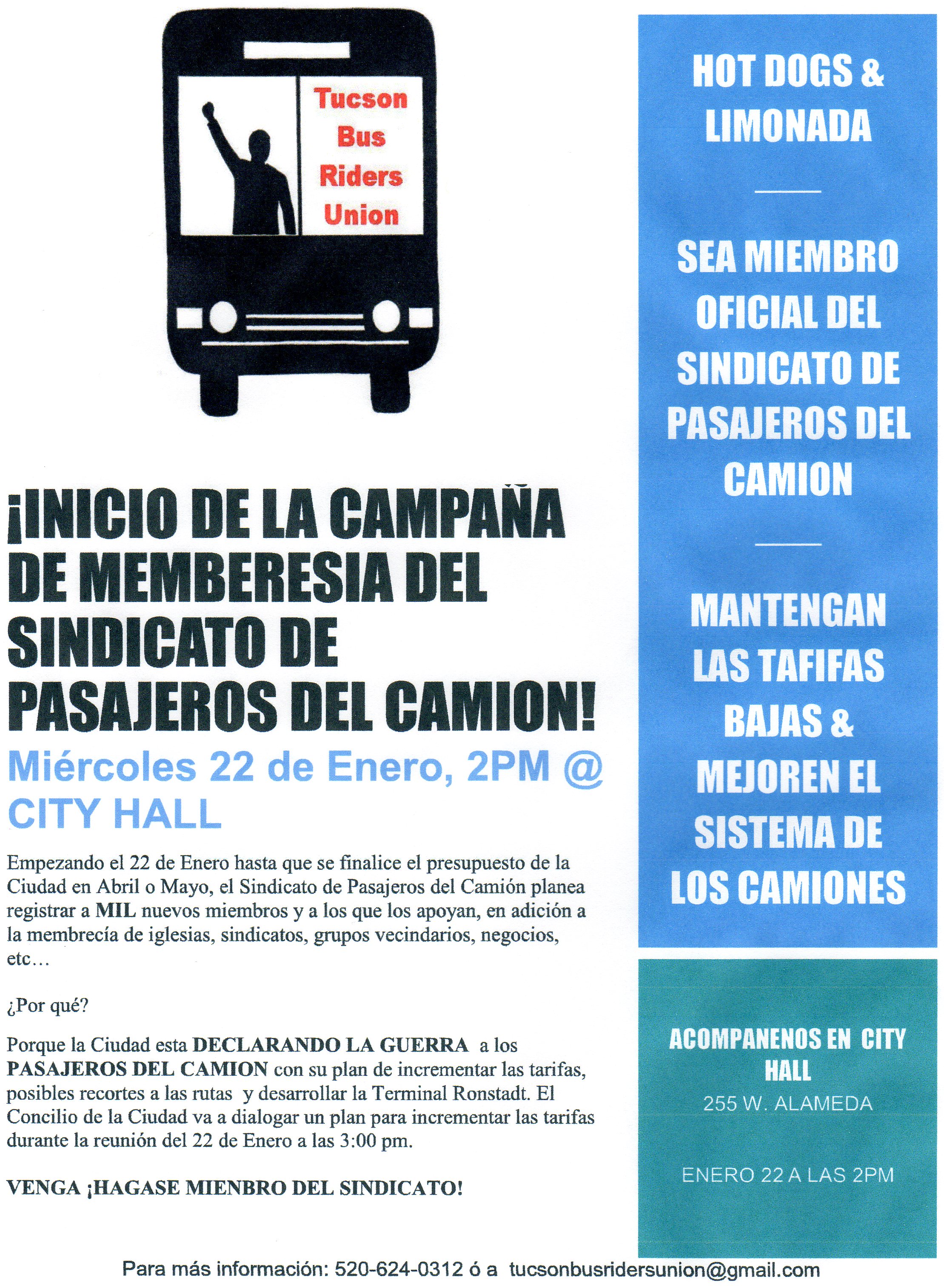
The City’s WAR on Bus Riders and the Bus Riders Union’s Campaign for Transit Justice!
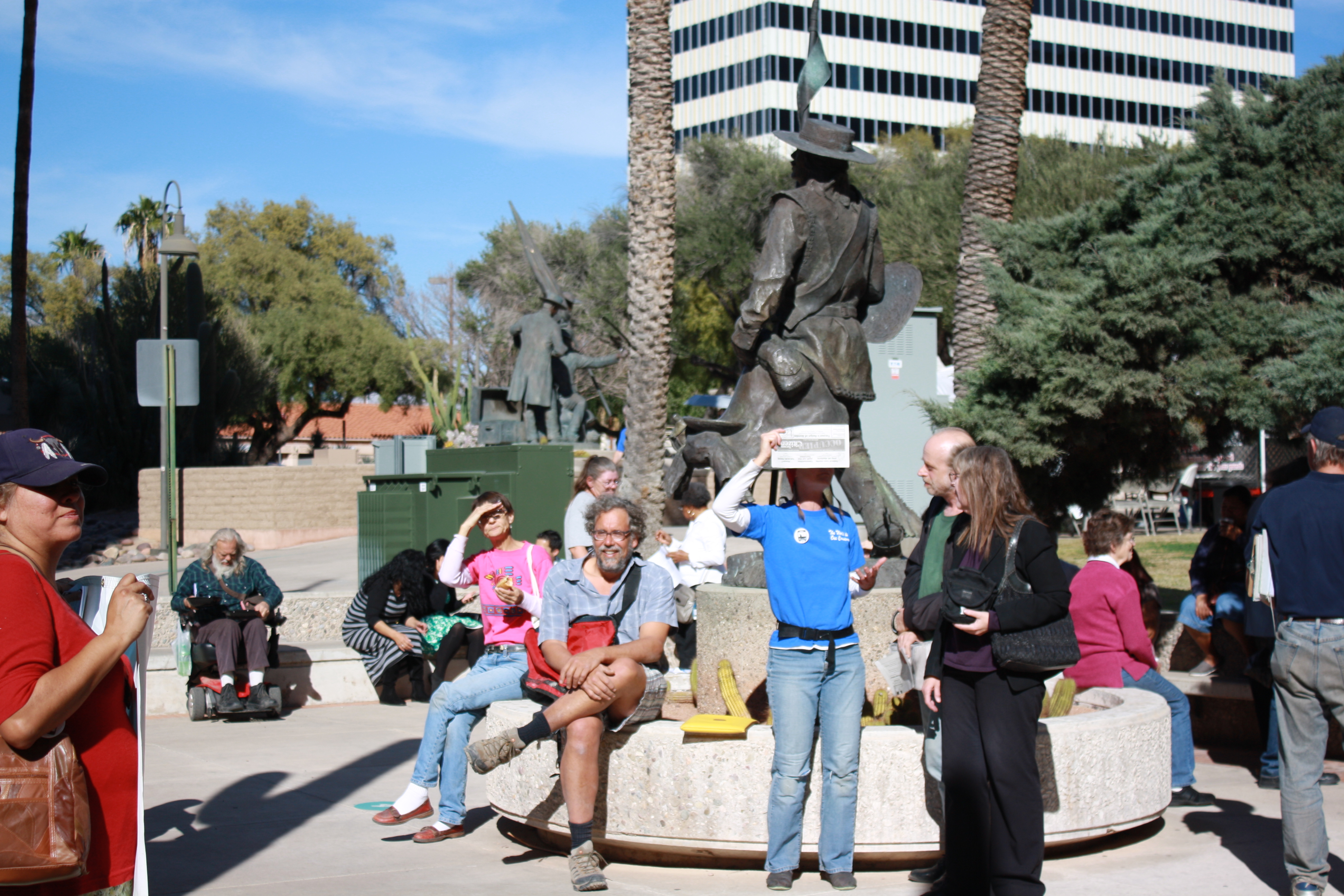
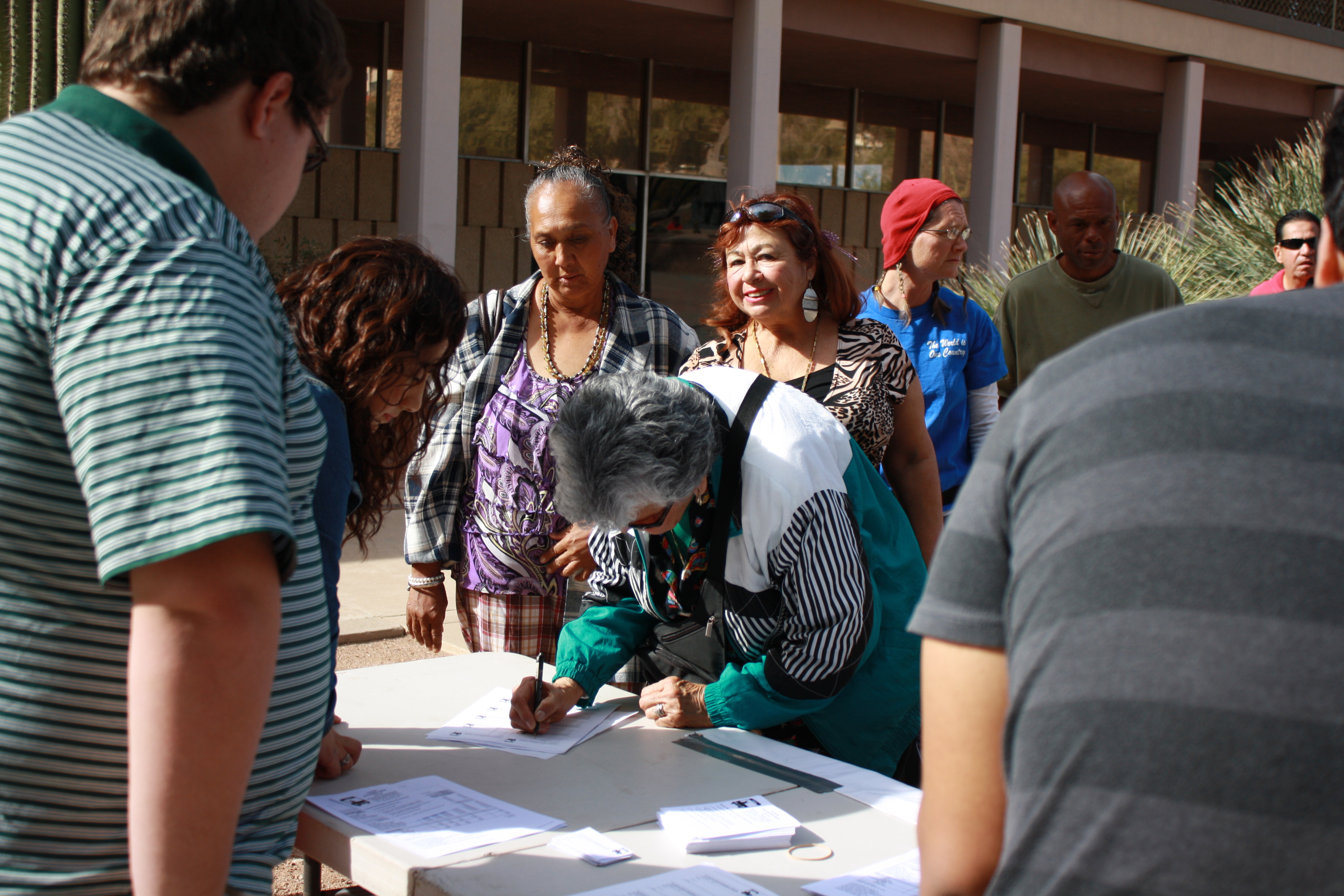
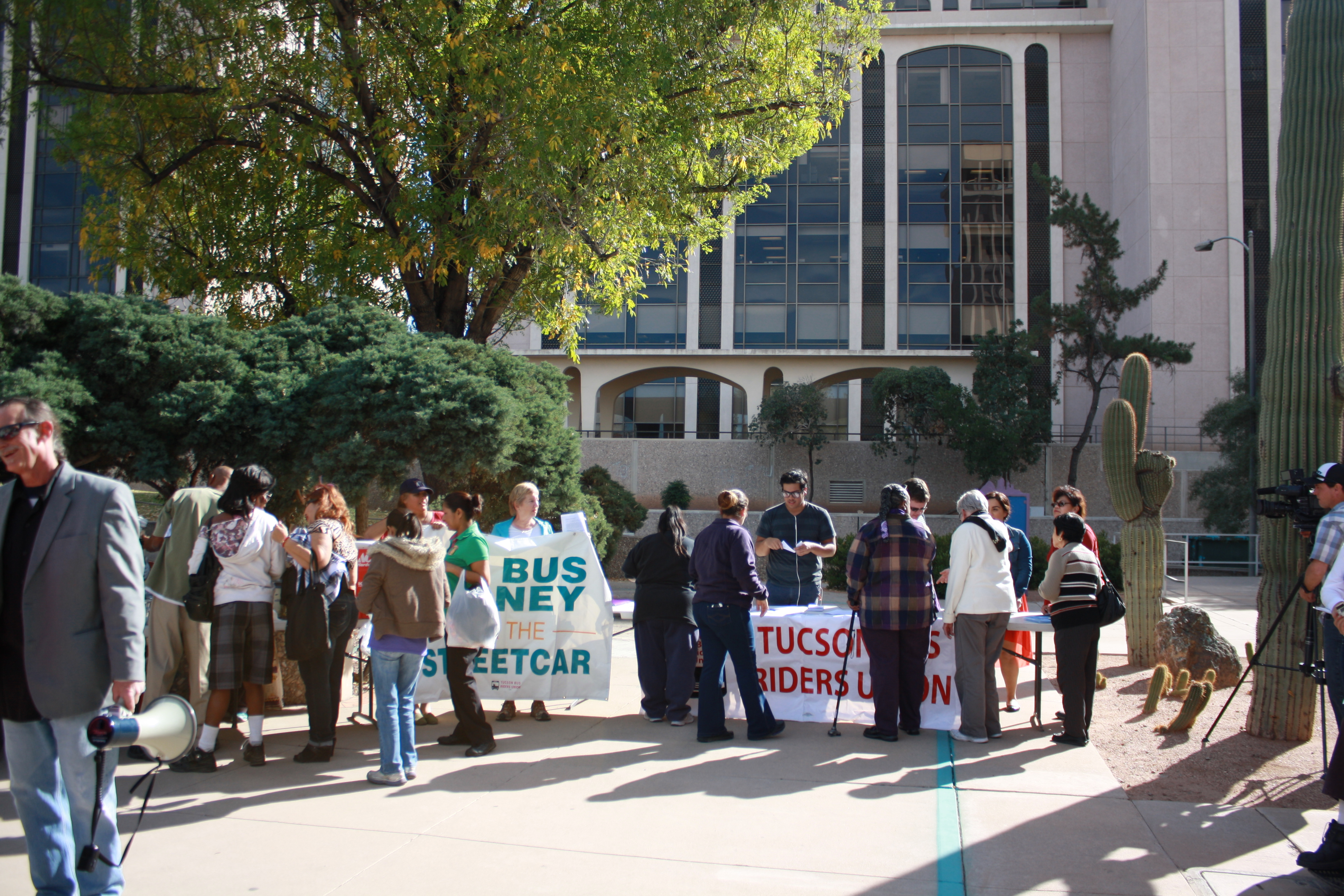
We signed up 150 new members for the Tucson Bus Riders Union at a Membership Campaign Kickoff party outside of City Hall on January 22.
Our goal is to sign up ONE THOUSAND new bus riding members and their supporters by the time the City budget is finalized in April or May.
The Mayor (who doesn’t seem to like us?) pulled the fare increase off their January 22 agenda. It will be heard on either February 4th or February 18th.
We will be there – in force!
Council members Ulich and Fimbres have committed to vote NO to fare increases this year. We need 2 more votes.
Stay tuned!

BUS RIDERS PRESENCE AT MLK MARCH A SUCCESS

by Cesar Aguirre

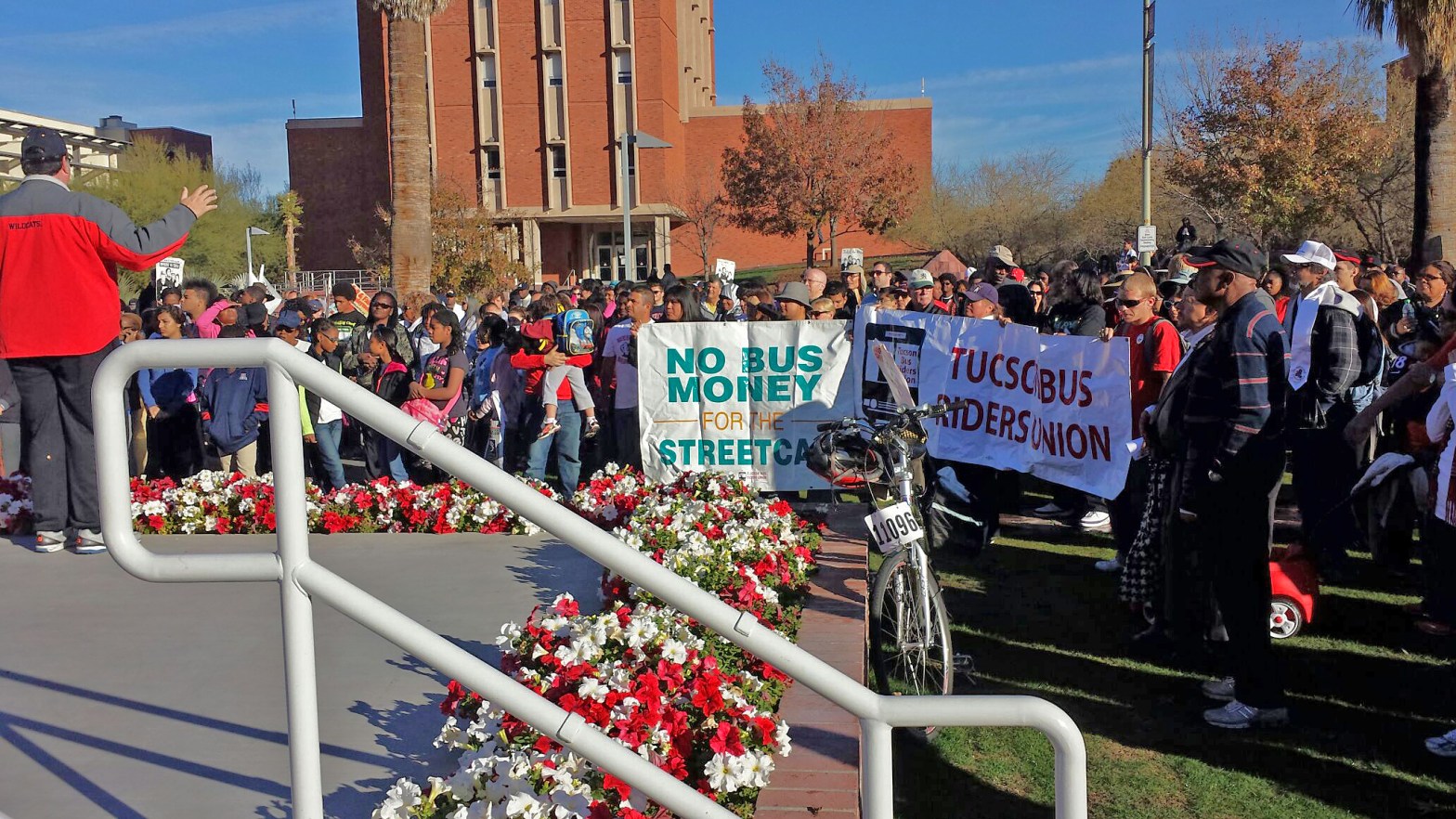
It was a warm, bright morning as Mayor Rothschild spoke to a large crowd at the U of A mall, along with many other politicians including Karen Uhlich, Regina Romero and Richard Fimbres. There we were, right up front, with two large Tucson Bus Riders Union banners. As we listened to them speak about justice, equality and human rights, a new hope began to arise that we could possibly work with our all-Democrat City Council members to insure that fares are not increased, routes are not cut, and that there be a true, transparent public process in the development of The Ronstadt Transit Center, insuring that its development truly benefits the bus riders and improves the transit system.

Once the march to Randolph Park began the Bus Riders Union Team started working the crowd, handing out fliers and informing people of the city’s plan to discuss fare increases on Wed. Jan. 22nd at City Hall. I spoke to many people that were very upset by this topic. One gentleman was so angry that we discussed it for nearly five minutes. He told me that it was nonsense, and that the only reason they are discussing fare increases is to pay for their precious street car. He said that it’s not right that we [bus riders] have to pay for something that most of us will never use. I agreed and invited him to join the Bus Riders Union before continuing to work the crowd and hand out fliers.

The crowd was upbeat and enthusiastic. The music and performances were wonderful. This was the perfect event to reach out to fellow bus riders and our supporters and spread the word about our Membership Campaign Kick-off on Wed. Jan. 22nd at 2:00 in front of City Hall, 255 W. Alameda. Please join us and sign up for your official Bus Riders Union Membership. Until the City Budget is finalized in April or May, the Tucson Bus Riders Union plans to sign up ONE THOUSAND bus riding members and their supporters in addition to membership from churches, unions, neighborhood groups, businesses, etc. Hopefully the City Council members will hold true to their words of justice, equality and human rights by stopping the war on the poor and not balancing their budget on the backs of those who can least afford it.

Stories of Liberation: Gabriella Dominguez

by Kassandra 

Six years ago, Gabriella Dominguez stopped by Casa Maria in need of a dozen tortillas; this visit prompted her six-year volunteer endeavor at Casa Maria.

Image

Gabriella, a Nogales Sonora native, along with her two children moved to Tucson nine and a half years ago when her paycheck in Nogales didn’t cut it anymore. In Nogales, Gabriella held a position in human resources and studied “Lic. Administracion de Expresas.”

Marriage troubles and financial struggles motivated her move to Tucson where she temporarily lived with her brother and cleaned homes. Later, she applied for a position at Food City on Sixth St. near the Freeway. She’s going on her ninth year working in the Food City carneceria at a location that employs many members of the Casa Maria barrio.

Both of Gabriella’s children, Gabriella Garcia, 24, and Ruben Garcia, 20, are graduates of Pueblo High School and are seeking degrees at Pima Community College. Both Gabriella and Ruben spoke only Spanish and were thrown into English-only classes at their respective Tucson schools. Within a year both spoke fluent English.

Gabriella Garcia is married and pursuing a degree in education, while Ruben is studying Computer Science and Systems. Both are studying at Pima Community College.

In addition to his interest in Computer Science, Ruben is a musician who plays multiple instruments including the guitar, organ and piano. A music class that he took at Wakefield Middle School triggered his interest in the subject.

Ruben as he was nicknamed by his high school friends, “El Zurdo” (the lefty), is impressively a self-taught pianist and multi-instrumentalist.

When Gabriella isn’t working at Food City, she’s spending time with her family or volunteering at Casa Maria. Gabriella dedicates herself to Casa Maria as much as she can; typically she volunteers on days that she is scheduled to work evenings at Food City as well as her days off. Gabriella assists in the Soup Kitchen and also oversees the showers and clothing donations at Casa Maria.

THANK YOU…

Jarvis

by Brian Flagg,

To everyone who donated to Casa Maria this holiday season. We exist entirely on private donations, so many more people would be more hungry and desperate and without a voice if not for the generosity of the donors.
Often times we get supportive notes along with a check or some cash. These warm my heart and help sustain me in the struggle.
Here is one of my faves:

                                                                                                                                                           12/17/13
Dear Brian and all at Casa Maria,
Enclosed is a check in the amount of $60 which represents a week’s salary for each of  the six staff members. I wish it could be more!
This donation is in gratitude to God for the election of Pope Francis, who behaves more like   a Catholic Worker than a prince. May he, and you, be an example to all of us, Catholic or not, who try to walk our talk.

                         Have a very Merry Christmas and a blessed New Year!

                        Peace, Christina

 Christina Jarvis is a renowned pianist and community activist who resides in the Feldman Neighborhood.
_________________________

por Brian Flagg,

 Gracias a todos los que donaron a Casa María en esta temporada Navideña. Nosotros existimos solo de donaciones privadas, muchas personas estarían más hambrientas, desesperadas y sin una voz si no fuera por la generosidad de los donantes.

 Muchas veces recibimos notas de apoyo junto con un cheque o efectivo. Esto calienta mi corazón y me ayuda a continuar en la lucha.

 Aquí hay una de mis favoritas:

                                                                                                                             12/17/13

                      Estimado Brian y todos en Casa María,

                      Adjunto hay un cheque por la cantidad de $60 dólares los que representan una semana de salario para cada uno de los seis empleados que tienes. ¡Desearía que pudiera ser más!
Esta donación es en gratitud a Dios por la elección del Papa Francisco, quien se comporta mas como Trabajador Católico que un príncipe. Que él y tú sean un ejemplo para todos nosotros, Católicos o no, que tratamos de hacer lo que decimos.

                     ¡Que tengas una Feliz Navidad y bendiciones en el Año Nuevo!

                      Pace, Christina

 Christina Jarvis es una reconocida pianista y activista comunitaria que reside en el vecindario Feldman.

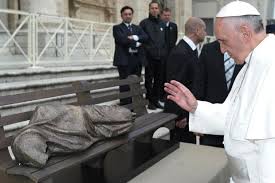
Pope Francisco – ONLY SYMBOLS OR REAL CHANGE?

POPE

‘Jesus the Homeless’ in Rome

by Brian Flagg,

From reading the National Catholic Reporter for many years I have learned that Popes can write encyclicals and say many good things but who gets appointed Bishop or Cardinal is much more important.

In the most recent NCR, John Allen described how on December 18, Pope Francis “delivered a bombshell in the form of a shake-up at the Vatican’s all-important Congregation for Bishops, the office that is responsible for recommending bishops’ appointments to the pope.”  Allen said that

“All told, the overhaul arguably represents one of the more important reform moves by Francis, given that it shapes the criteria by which more than 5,000 Catholic bishops around the world will be chosen.”

And also from the magazine called The Week (Dec. 27, 2013), Pope dismisses U.S. cardinal:

“Pope Francis has demoted an ultraconservative U.S. cardinal who outspokenly disagreed with his attempts to focus the church less on issues like abortion and more on spreading the faith and caring for the poor. Cardinal Raymond Burke was removed from the body that helps choose bishops after giving an interview questioning the pope’s views. “He thinks we’re talking too much about abortion, too much about the integrity of marriage as between one man and one woman,” said Burke. “But we can never talk enough about that.” Burke, the former archbishop of St. Louis, is best known for saying in 2004 that he would deny communion to then – presidential candidate John Kerry because Kerry is pro-choice.”

So it seems that the Holy Father is not all talk, he puts his words into action!    

LA MORENITA

rigoberta-menchu

by Kassandra Manriquez,

La Morenita is from Guatemala. This is the story of her crossing borders to get here 16 years ago. She has four kids who go to Ochoa and Safford. She works part time at a tortilleria and is a valued member of the core team here at Casa Maria.

Soon before her arrival at the border that would lead her into Mexico City, Morenita met a woman who saved her life, a miracle from the Virgin Mary she said.

“For everyone who makes it across the border alive, it’s a miracle from God,” Morenita said. “Those of us who arrive thank God for the opportunity to arrive.”

At 21 years old Morenita immigrated to the United States from Guatemala by herself and pregnant. She left behind her husband and her daughter who is now 18 years old.

Morenita’s trip lasted just over six months. While in Mexico, Morenita held several jobs as she traveled from city to city, making just enough money for her travel expenses.

As Morenita arrived at the Mexico City border, there was a river that was rushing and was rigorous to pass. She came across an older woman who convinced her to stay at her home for the night.

Despite her hesitancy to stay with this woman, she stayed the night. The woman brewed Morenita a cup of coffee and sent her on her way the following morning.

When Morenita arrived back at the wash, there was blood flowing in the water and puddles of blood nearby.

Once Morenita crossed the wash, she spotted investigators who asked her if she knew what the cause of the murders had been. They told Morenita that the bajadores who helped a group of Salvadorians and Guatemalans cross the border had killed this group of immigrants the previous night.

Morenita would have been part of this group of immigrants if she hadn’t stayed the night with the older woman. Morenita credits the Virgin Mary for this blessing.

At last, Morenita arrived in Nogales, she was under the impression that this was it; she was in the United States.

Unfortunately, her arrival in Nogales was the beginning of an entirely new set of challenges. These challenges forced her to stay in Nogales for a week and half to save money.

She stood on street corners and washed cars. It was at this time Morenita missed her family; she is the youngest of 12 siblings.

Morenita met a family who helped her cross the border; they traveled from freight train to freight train until they made it across the border. Morenita arrived at the United States with just enough time to give birth to her son.

“I give thanks to God because I have my children, even though we don’t have a lot of money, my family is all I have and all I need. My children were all born here in the United States and that’s a beautiful thing. To me, my son being born here is a blessing because it is hard to live without papers. I’m here to work for my kids. We’re not rich; we’re poor, but as long as I have my family, I am rich,” Morenita said.

___________________________

por Kassandra Manriquez,

La Morenita es de Guatemala. Esta es la historia de ella cruzando las fronteras para llegar aquí hace 16 años. Ella tiene cuatro hijos que asisten a la escuela Ochoa y Safford. Ella trabaja medio tiempo en una tortillería y es un miembro muy valioso de nuestro equipo aquí en Casa María.

La Morenita dice que antes de llegar a la frontera que la llevaría hacia la Cuidad de México, se encontró con una mujer que le salvo la vida, un milagro de la Virgen María ella dice.

“Todos los que logran cruzar la frontera con vida, es un milagro de Dios,” dice la Morenita. “Para nosotros que logramos llegar, le agradecemos a Dios la oportunidad  de haber llegado.”

A los 21 años de edad, la Morenita migró a los Estados Unidos desde Guatemala, sola y embarazada. Ella dejo atrás a su esposo y a su hija que ahora tiene 18 años.

El viaje de la Morenita duro un poco más de seis meses. Mientras ella estaba en México viajando de ciudad en ciudad, ella tuvo bastantes trabajos, consiguiendo justo lo suficiente para pagar sus gastos.

Cuando la Morenita llegaba a la frontera de la Ciudad de México, había un rio que corría rápidamente y era difícil cruzarlo. Ella se encontró con una mujer anciana que la convenció a que se quedara en su casa aquella noche.

A pesar de sus dudas ella decidió quedarse con esta mujer a pasar la noche, La mujer le hizo café y la mando a que continuara su camino al día siguiente.

Cuando la Morenita regreso a lugar del rio, habían charcos de sangre, y veía como la sangre corría por el agua.

Una vez que la Morenita cruzo el rio, ella vio a unos investigadores, los que le preguntaron si ella sabía cuál fue la causa de las muertes. Ellos le dijeron a la Morenita que los bajadores que estaban ayudando al grupo de Salvadoreños y Guatemaltecos a cruzar la frontera mataron a este grupo de inmigrantes la noche anterior.

La Morenita hubiera sido parte de este grupo de inmigrantes si ella no se hubiera quedado a pasar la noche con esa anciana. La Morenita le da crédito a la Virgen María por esta bendición.

Al fin, la Morenita llego a Nogales, ella tenía la impresión que ya estaba al final, que ella estaba en Estados Unidos.

Desafortunadamente, su llegada a Nogales fue el comienzo de muchos retos nuevos. Estos retos la forzaron a quedarse en Nogales por una semana y media para ahorrar dinero.

Ella se paraba en las esquinas a lavar carros. Fue entonces que la Morenita empezó a extrañar a su familia; ella es la menor de 12 hermanos.

La Morenita conoció a una familia que la ayudo a cruzar la frontera. Viajaron de un tren de carga a otro hasta que lograron cruzar la frontera. La Morenita llego a los Estados Unidos justo para dar a luz a su hijo.

“Yo le doy gracias a Dios porque tengo a mis hijos, aun que no tenga mucho dinero, mi familia es todo lo que tengo y todo lo que necesito. Todos mis hijos nacieron aquí en los Estados Unidos y eso es algo precioso. Para me, el que mi hijo haiga nacido aquí es una bendición porque es difícil vivir aquí sin papeles. Yo estoy aquí para trabajar por mis hijos. No somos ricos dice la Morenita, somos pobres, pero mientras tenga a mi familia, soy rica.”