Santa Catalina Catholic Parish Spices Up the Casa Maria Soup Kitchen

by John Tancock, Project Leader for the Santa Catalina Social Awareness Ministry

Volunteers from the Santa Catalina Catholic Parish have been working on various upgrades for the soup kitchen and house bathroom since early February. The church’s Social Awareness Ministry asked Brian Flagg if they could work on some improvements and Brian was enthusiastic for the help. We asked Brian what his primary need was; without hesitation he talked about the large stoves in the kitchen that needed to be replaced. The Santa Catalina team led by Sr. Jean Mariani and John Tancock inspected the kitchen with Brian and noted several areas that could be worked on in addition to the stoves.

The stoves are used to make soup for 500 hungry people every day and indeed looked like they were in serious need of replacement. Brian was particularly concerned about the continuous burning pilot lights and the gas wasted. We researched replacement stoves and hired a plumber to inspect the gas supply for the replacement. There were two Wolf brand stoves, each having two burners, totaling four burners. (Each burner uses 110,000 Btu’s per hour which is nearly three times the gas used by a typical four burner range; total demand 220,000 Btu’s/hr.). These stoves generate a tremendous amount of heat in a tiny kitchen serving hundreds of hungry patrons nearly 365 days a year.

As it turned out, the stoves looked bad and had broken parts, but could be cleaned and refurbished easily and at a significantly reduced cost. The stoves are mostly steel, cast iron and a little tubing, so they are solidly constructed only needing “a little TLC” – hey, who doesn’t? One new stove of comparable performance retails for about $4,200. With Brian and Cesar Aguirre’s agreement, we decided to go the refurbishment route, repairing all four burners for about $900.

In the process, we learned that the gas supply was severely undersized which may have contributed to the “flameouts” staff was experiencing. We hired a plumber to upgrade the gas supply, bringing it into compliance with burner requirements.

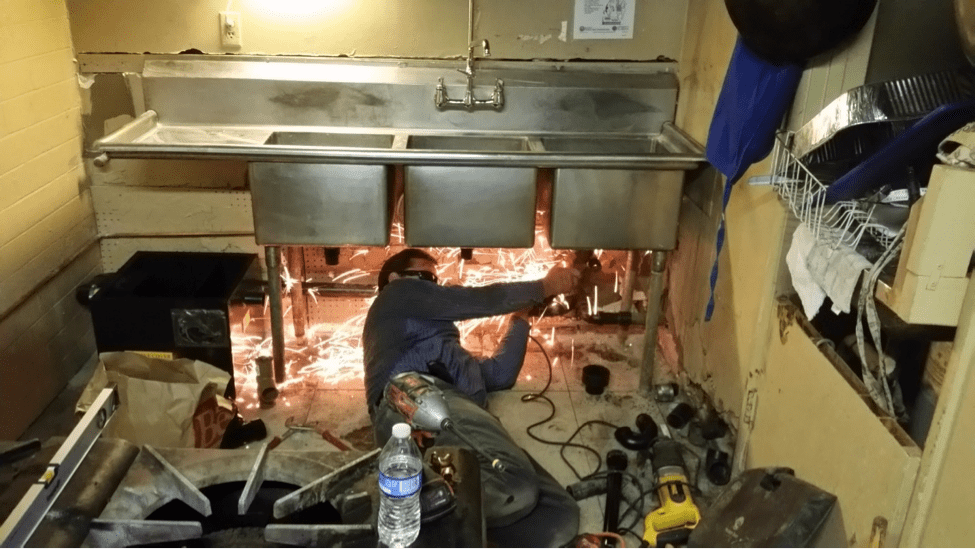
Another priority on Cesar’s list was the sink and drainage system. On first inspection, the drains were leaking, with pots and pans on the floor catching the leaks. Casa Maria knew they needed a grease trap and sanitary sink arrangement. We explored replacing the sink with a new, larger three compartment arrangement that would accommodate the large (20” in diameter) pots, but the room was so small, it would not accommodate a sink any larger than what they had. We elected to add a trap and a sanitary drain using the existing three compartment sink.
Untitled

NEW GREASE TRAP (BLACK BOX MIDDLE LEFT) & SANITARY DRAIN ADDED

The soup kitchen is an amazing production. Staff and volunteers produce coffee, breakfast, soup, snack packs and family sacks for 500 or more people almost every day, all in the space of less than 600 square feet, all served in roughly three hours. One area of focus that the Santa Catalina volunteers observed was this group of amazing people need a little help organizing their tiny workspace so they can do their job easier and more efficiently.

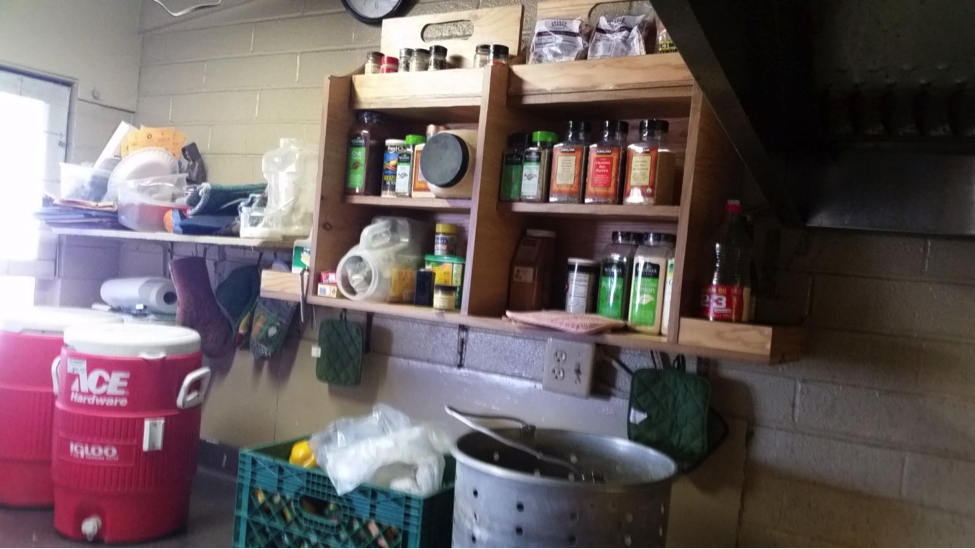
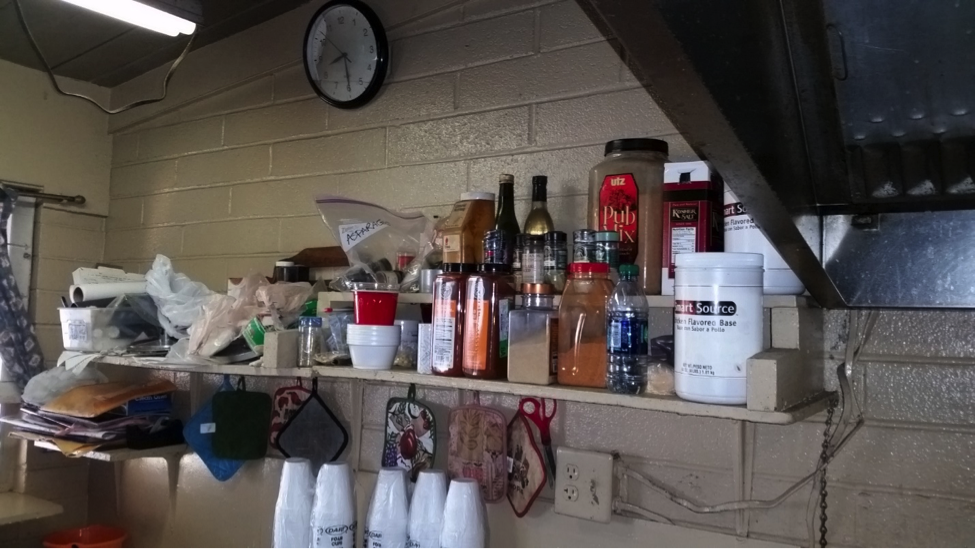
To that end, additionally we looked at making their space more efficient with simple improvements, increased storage and improved lighting. The spices the cooks used were haphazardly stored on a shelf, near the cooking area, and not easily accessed. We built and stocked a custom spice rack to make this task a little easier.
Untitled

SPICE SHELF BEFORE

Untitled

WITH NEW CUSTOM SPICE SHELF

Another small, but helpful improvement was how the large (12 – 15 gallon) pots get filled with water to make large quantities of soup. Previously, staff would carry buckets from sink to pot. Now they have a dedicated water line and pot faucet over the stove that can fill the soup pots with little effort.

Untitled

NEW POT FAUCET EASILY FILLS THE LARGE SOUP POTS 

Another small improvement was with new lighting for a dimly lit, small space. High efficiency lights were added in three rooms to dramatically improve workspace lighting.

Untitled

KITCHEN SINK AREA LIGHTING BEFORE

Untitled

SINK AREA LIGHTING AFTER. (NOTE NEW PRE-RINSE FAUCET)

All in all, Santa Catalina managed roughly $10K in small and significant improvements of the soup kitchen and house bathroom since February. We plan to take mid-summer off and visit with Brian and staff late in summer to see what else can be improved.

Our thanks to Brian, Cesar Aguirre, Lonny, Chad, Mayola, Cesar, Amalia, Jimmy, and Laura for their cooperation and input. Our apologies for the dust and inconvenience – we hope and pray you like the changes. We look forward to working with you again in the future.

Editors note – Make no mistake, Casa Maria is extremely thankful for John Tancock and Santa Catalina Parish! 

_________________________________________________________________________

Este blog post, por John Tancock de la Iglesia Catolica Santa Catalina en Oro Valley, es sobre sus fuerzas para arreglar y mejorar muchas cosas en la cocina gratis aqui.

Arreglamos las estufas grandes, los lavatrastos y la systema de drenaje, agregó una trampa para grasa, y nuevos gabinetes y un nuevo systema de luz. (Mira a los fotos!)

Casa Maria dice MUCHAS GRACIAS a John Tancock y la Iglesia Santa Catalina.
It’s time that we all understand water politics by madeline kiser

Madeline

by Madeline Kiser

The papers are full of news about water, our waning Colorado River, life-blood source for western states, and it’s hard to tell, reading, what our options are amidst the complex data.

We know that the river is over-allocated, even without climate change.

We know that it’s likely that a shortage on the river, which supplies 35-40 million people, seven states, and much of our agriculture in the U.S., will likely be declared in the next few years, or even months.

We know that it’s likely that to meet the shortage, conservation efforts will be intensified; water will be transferred from farms to cities; we will treat water to potable levels; we will look to desalination, cloud seeding and other technological options.

There’s a lot we don’t know, though. We don’t know who, specifically, in Arizona and in the West, is deciding our water future—which agencies and people, and how they overlap. We don’t know where steady, intensive funding streams for changes we need to make will come from in an era as dry financially as it is hydrologically. We don’t know if we’re doing all we can for ourselves and compared to other areas of the world that are facing situations similar to our own with principles codified into laws and institutions that vary greatly from ours. Around the world monumental change in how water is managed is taking shape, defined by the understanding that nature and people have the first right to water.

We don’t know if the entire way we manage water—our management framework—is as sound and just as it could be, in a time of profound environmental, social and economic change.

In a true water democracy, asking and answering these questions becomes a shared process, involving everyone.   Though difficult to implement and facing many challenges, some of the world’s best water laws were written in South Africa during Nelson Mandela’s tenure. They allocate the right to water first to the environment (this, because if you kill the goose that lays the golden eggs, you don’t get the eggs—the environment produces water) and to people, in what is called the Reserve. This amounts to a reversal of how water rights have functioned in much of the world, including in our state.

In order to create a transparent, inclusive conversation about our water future in Arizona, we need, first, to equitably engage citizens in water debates, much as Casa Maria and the Tucson Bus Riders Union have in the area of transportation.     Perhaps we need some sort of a state-wide citizens’ advisory board, as the time for calling a shortage on the Colorado approaches, or a less formal entity and process for publicly questioning what we are choosing in the context of global best practices for managing water. These are shifting from de facto investing in expensive high-tech options, such as desalination, without significantly increasing conservation measures (Australia uses about half of the water we do) and employing other options, such as water transfers and trading.

It perhaps isn’t coincidental that South Africa has helped re-frame the way the world thinks about water.   Water experts there involved in helping make this shift from what is a more individualistic, consumptive model of using and allocating water to one based on principles of equity and stewardship speak of having lived through and been shaped by the transition from apartheid, absorbing the experience of non-violent action. Their science is permeated by this lived experience.

I don’t believe one sector or sectors deserve the blame entirely for this moment we find ourselves in, water being wasted, great inequality, silence from those who must have a voice, our future imperiled if we don’t shift from consumption and isolation, to–as Pope Francis says–joyful solidarity.  (Poverty, after all, is also poverty of the spirit, and a narrative of individualism and consumption seeps into each one of us, creating fear.)

I believe we must step beyond our fear and our shared ignorance of the precariousness of this moment, with a drying planet, a waning river here in our U.S. West, into that difficult, necessary space of risking all to question and engage, to love fully and fearlessly, shaping a true water democracy.

____________________________________________________________________

Los periodicos están llenos de noticias acerca del agua, nuestro menguante rio colorado, recurso de sangre viva para los estados del oeste, y es difícil decir por escrito, cuales son nuestras opciones enmedio de tan complejos datos.

Sabemos que el rio esta sobre esignado an sin cambios de clima.

Sabemos que problamente un “recorte” en el rio, el cual suministra de 35 a 40 millones de personas, en 7 estados y much de nuestra agricultura en la nación sera probablemente declarado en únos cuantos anos o tal vez meses.

Sabemos que tal vez nos enfrentemos a los recortes, y esfuerzos de conservación serán intensificados, el agua sera transferida de las granjas a las ciudades; trataremos de mejorar su potabilidad y mirando a la des alinizdeion y la exitacion de nubes y otras opciones technológicas.

Hay much de lo que no sabemos. No sabemos quien especificamente en Arizona y el Oeste, está decidiendo por el futuro de nuestra agua. Lo cual agencias y personas de alguna certidumbre, necesitamos una intensiva corriente de cambios que vendra como resultado en una era de resequedad financiera tanto como Hidrológica. No sabemos se estamos haciendo todo lo que podemos por nuestros mismos, y comparado con otras partes del mundo, que están enfrentando situaciones similares a la nuestra, con nuevos codigos aplicados a las leyes e instituciones que varian grandemente de las nuestras.

Arrededor del mundo un monumental cambio en como manejar el agua está tomando brillo manejar.

Defimendo por la naturaleza del entendimento de que las personas tienen derecho al aqua.

No sabemos si nuestro absoluto manejo del agua – nuestra estructura de manejo, suena como bebería ser, en un tiempo de profundos cambios ambientales, sociales y económicos.

En una verdadera democracia del agua. preguntar y responder a estas preguntas se convierte en un proceso compartido involucrándonos a todos. Altravez de la dificultad para implementar y enfrentar muchos desafíos.

Algunas de las mejores leyes hidráulicas en el mundo fueron escritas en sudáfrica durante la tenencia de Nelson Mandela. Ellos asignaron el derecho al agua primero al medio ambiente (esto es per que si matas a la ganza de los huevos de oro te quedas sin los huevos) (el medio ambiente produce agua) y para la gente.

(Australia usa casi la mitad del agua que nosotros) y empleando otras opciones como intercambio y tranferencia del agua.

No es ninguna coincidencia que sudáfrica a ayudado a reformar la maner en que el mundo piensa con respecto al agua.

Los ahí involucrados expertos del agua ayudando en estos cambio desde; cuales el mas individualista modelo de consumo a llevar a cabo asignamdo agua al individuo basado en principios de igualdad administrativa, hablar de tener vivido trayecto conformado por la transición desde la segregación. Absorbiendo la experiencia de las acciones no violentas. Su ciencia es permitida por esta experiencia viva.

No creo que uno o varrias sectores deban segarse por competo debido al momento, en que nos encontramos por nosotros mismos, agua, gran desigualdad, en el silencio de aquellos que deberían tener voz.

Se no cambiamos del consumismo y aislamiento a como nos dice el papa Francisco “gozoso en solidaridad” (Pobreza ante todo, es tambien pobreza de espíritu, y una narrativa de individualismo de consumo se filtra a cada uno de nosotros, creando miedo.

Creo que devemos avanzar mas alla de nuestros miedos e ignorancia compartida de la precariedad del momento con un planeta en resequedad. Con un decadente rio aquí en el oeste de nuestra Union Americana. Rumbo a lo difícil, es necesario abrir espacio de arriesgarnos a cuestionar y relacionar, para amar por completo sin miedo, conformando una  verdadera democracia Hidráulica.

TUCSON BUS RIDERS UNION NEWS-THE POSITIVE SPIN

by Brian Flagg,

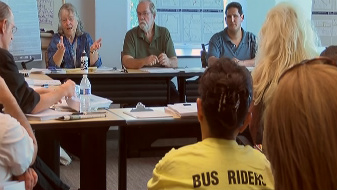
Approximately 30 of us from the Bus Riders Union, loud and proud, attended the emergency Transit Task Force meeting yesterday. Our presence there helped the Task Force vote to stop $458,000 of the proposed $1.1 million in cuts to 9 bus routes.

IMG_20140331_093104

Particularly disappointing was a 4-3 vote to reduce frequency on the Broadway bus (the #8).

I am trying to be positive about this. Our efforts did force a process that will restore a small portion of the cuts.

So why do I feel so frustrated?

I guess this makes me evaluate our recent bus rider organizing efforts (or lack of). Organizing is about power to the people, and power is relational. Maybe we have to sit down and strategically develop a plan to develop more, better and deeper relationships with people, especially among our base, the bus riders.This would also be our base for broadening our relationships and alliances with other community entities.

The implementation of this kind of power is soul power. The kind of power that leads to the phrase, the people united can never be defeated! And make no mistake, it needs to be based in relationships.

The actualization of such power is what will lead to not being sold out by politicians and bureaucrats in the future.

Maybe we should forget about positive spin and acknowledge we got our asses kicked on this one. We’ve got a lot of work to do!

EL GIRO POSITIVO

por Brian Flagg

Traducción por Cesar Gonzalez

Mas o menos 30 miembros del Tucson Bus Riders Union asistimos a la junta de emergencia del Transit Task Force de la ciudad de Tucson. Hicimos un orgulloso escándalo. Nuestra presencia fue importante. El Task Force votó rehusando a los $458,000 de cortes que la ciudad quería imponer en los pasajeros del camión.

La cosa mas mala que ocurrió fue 4-3 votos a reducir frecuencia en el camión numero 8, el camión de Broadway.

Estoy luchando en portarme positivo.La suma que protegimos fue chica pero nuestro esfuerzo fue importante.

Porque me siento tan frustrado?

Estoy estoy aquí evaluando nuestro trabajo de esfuerzos organizados. Organizarnos es acerca de fortalecer al pueblo, y es fortalecer relaciones. Tal vez necesitamos pensar sobre un plan a desarrollar mejor y mas profundas relaciones con mucho mas gente, especialmente con nuestra base de pasajeros. También necesitamos pensar sobre nuestras relaciones con otros grupos en la comunidad.

Estamos hablando del poder del alma. Este tipo de poder va a producir UN PUEBLO UNIDO JAMAS SERA VENCIDO! Este tipo de poder es sobre relaciones.

Cundo tenemos este poder, los políticos y los burócratas no pueden prostituirnos.

Tal vez necesitamos a olvidar el giro positivo. En este evento, fuimos locos perdidos (como dice el Chapo de Sinaloa). Tenemos Mucho trabajo por hacer.

ATTENTION: BUS RIDER UNION MEMBERS DEFEND THE BUS FROM $1 MILLION IN CUTS TUESDAY JUNE 23 3pm AT CITY TRANSIT BUILDING 149 N STONE AVE FLOOR 2

TBRU Logo

by Brian Flagg,

The City Staff ordered this EMERGENCY meeting of their Transit Task Force.

We need Union members to be there to back up Task Force members Suzanne Schafer and Brian Flagg as they encourage the Task Force to not okay the cuts, especially the cuts in frequency to some routes.

When the City Council passed their budget on June 9, they did so saying that these cuts were subject to the input of the Transit Task Force.

Right now there are signs and flyers on the buses saying the cuts take effect on August 2. This can be partially or totally undone depending on how this meeting goes!

Please show up in your yellow Bus Rider Union T-shirt.

Date: Tuesday, June 3, 2015

Time: 3 p.m.

Location: City Transit Building (149 N. Stone)

For more info:520-624-0312

______________________________________________________________________________

GOLPES A LOS PASAJEROS DEL CAMION POR LA CIUDAD DE TUCSON

por Brian Flagg,

Los politicos de la Ciudad de Tucson pasaron sus prosupuesto para el proximo ano en 9 de Junio. Pero lo hicieron con $1.1M en cortes al servicio de 9 rutas del camion. Este plan vino de el alcade, Councilman Kozachik y el City Manager.

Pero fue un acuerdo por el concilio que antes de hacer los cortes, necesitarían el consentimiento de su comité, el Transit Task Force ye otro experto, Jarrett Walker. Este acuerdo vino de la campeona de los pasajeros, Councilwoman Karen Uhlich.

Pero los burócratas de la Cuidada no están escuchando a los lideres politicos como Karen. En lugarde, ellos pusieron anuncios en los camiones proclamando que los cortes van a empezar en 2 de Agosto.

Ellos no tienen respeto por el proceso, ni los comités de la Cuidad, ni su jefes, los politicos elegidos.

El Task Force votaron en 8 de Junio contra los cortes.

Pero los burócratas de la Cuidada de Tucson no fueron feliz con este decision y ellos quieren un nuevo voto.

Ellos están llamando para una Junta de Emergencia sobre esta onda. Ellos quieren que yo y los otros miembros del Task Force vayamos a cambiar nuestro voto y hacer golpes a los pasajeros. Que triste! Que injusto!

La Junta de Emergencia es MARTES 23 DE JUNIO, 3 EN LA TARDE, al la EDIFICIO DE TRANSPORTACION, 149 N. STONE AVE.

Ven a apoyar a Suzanne Schafer y Brian Flagg quienes son miembros de Transit Task Force.

Vamos a defender a los pasajeros al menos de algunas cortes.

Por favor, ven a esta junta, vestido en las playeras amarillas de Tucson Bus Riders Union.

Bus Riders Victims of Sneak Attack

LOGO BRUBy Brian Flagg

On Tuesday, June 9, the City Council passed their budget for next year. The City Manager, with the support of only Mayor Rothschild and Councilman Kozachik, tried to balance their budget with $1.1 million in cuts to nine bus routes.

Longtime transit champion Councilwoman Karen Uhlich, wise to the games they play but not wise enough, got the council to approve the budget with agreement that any cuts to bus routes would happen only after the completion of a Transit Envisioning Process led by planner Jarret Walker and input from the City’s Transit Task Force.

It is a fact that the Jarret Walker process is not yet finished.

It is a fact that on Monday, June 8, the Task Force voted unanimously to oppose the $1.1 million route cuts as a budget balancing measure and instead evaluate all proposed changes in the near future using the Jarret Walker process as a guideline.

It is also a fact that if you get on a bus today, there will be signs informing you of the nine route cuts that will take effect on August 2.

Apparently the bureaucrats can do anything they damn well please, no matter how they are directed by Council.

Because the Bus Riders Union is starting to breathe fire about this, the city bureaucrats are scurrying to and fro, needing to manipulate the process and figure out how to put a happy face on their abandonment of the agreed upon approach to funding and maintaining transit.

It is expected that the bureaucrats will call an emergency meeting of the Transit Task Force sometime next week. The aim will be to get my fellow task force members and I to reverse our position and vote for hardship and pain for the bus-riding public.

Why? Because the City staff is not happy with how their task force voted. They are expected to demand another vote a mere two weeks after the first vote. This is saying that the Transit Task Force (and all other City Citizen Committees) are nothing more than rubber stampers. The message is: “If you don’t vote the way we want, we will coerce you into voting again in two weeks.”

This is fake democracy.

The City bureaucrats have no respect for process.

They have no respect for their own Citizen Committees.

And they have no respect for their bosses, the members of the City Council.

What can you do?

Join the Bus Riders Union at the special Task Force meeting next week. Speak at the Call to the Audience.

STAY TUNED to this blog for date, time, and place!

This one promises to be exciting! Come join the fun!

Farewell to Casa Maria

image

By: Gilberto Contreras

Saturday, June 13th, will be my last day at Casa Maria de Guadalupe Soup Kitchen. It has been an incredible three months, but I was given the opportunity to work in California, and I took it.

It’s not easy writing this, simply because everyone will be deeply missed. All the people that volunteer, all the familiar faces that show up once or twice a week, be the El Rio clinic or retirees that have been volunteering for years.

But most importantly the women, the back bone, of Casa Maria are the people my heart will ache to leave. We have grown a huge bond in these past three months.

Laura, Morenita (Amalia), Mari, Gabi, Elsa, Barbie, have quickly become my family. They are the ones that I will miss the most.

The laughs, the conversations, the time spent with these women is what made working at Casa Maria incredible. They all have different backgrounds, different stories that I loved hearing and piecing together like a puzzle that never stopped growing.

Most of these women have been working at the soup kitchen for years and have their own bond with each other. I was grateful enough to be part of that. I am grateful enough to have won their trust and them mine.

Meeting their families, let it be offspring, grandchildren, parents, grandparents, extended family was a sign of love. A love that will never be replaced.

It’s not easy walking away from these women, especially knowing that they will have a tough time reorganizing the stations without ‘Un Hombre’ to do the heavy lifting.

They are the people that will be missed the most, and I will have them in my thoughts every day hoping they are good, safe, and happy.

———————————————————————–
Sábado, 13 de junio , será mi último día en la Casa María. Ha sido unos increíble tres meses, pero se me dio la oportunidad de trabajar en California , y lo tomé.

No es fácil escribir esto, simplemente porque todos serán profundamente extrañados. Todas las personas que trabajan como voluntarios, todas las caras familiares que aparecen una o dos veces a la semana, ya sea la clínica de El Río o jubilados que han sido voluntarios durante años.

Pero más importante es que las mujeres, la base, de Casa Maria son por quien mi corazón sufrirá dejar. Hemos crecido un enorme bono en estos últimos tres meses.

Laura, Morenita ( Amalia ), Mari, Gabi, Elsa, Barbie, se han convertido rápidamente en mi familia. Ellas son las que voy a extrañar más.

Las risas, las conversaciones, el tiempo con estas mujeres es lo que hizo que el trabajo, en Casa Maria, increíble. Todas ellas tienen diferentes orígenes, diferentes historias que me encantó oír y armar un rompecabezas que nunca dejó de crecer.

La mayoría de estas mujeres han estado trabajando en el cocina durante años y tienen su propio vínculo con los demás. Soy suficientemente agradecido de ser parte de eso. Soy lo suficientemente agradecido de haber ganado su confianza y ellos la mía.

Conocer a sus familias, sea descendiente, nietos, padres, abuelos, familia extendida era un signo de amor. Un amor que nunca será reemplazado.

No es fácil alejarse de estas mujeres, sobre todo sabiendo que van a tener un tiempo difícil reorganizar las estaciones sin ‘ Un Hombre ‘ para hacer el trabajo pesado.

Ellas son las personas quien yo voy a extrañar más, y voy a tenerlos en mis pensamientos todos los días esperando que estén bien, seguros, y felices.

THANKS TO THE KNIGHTS OF COLUMBUS FROM ST. MARKS CATHOLIC CHURCH IN ORO VALLEY!

IMG_5108 Serving

By Kassandra Manriquez,

 Fifteen Knights from the Knights of Columbus and their family members volunteered here at the soup kitchen for the first time on Saturday, June 6th.

St. Marks has 115 Knights who serve the Tucson community through various projects and fundraisers.

Members of St. Marks delivered a clothing donation to Casa Maria a few months ago and were inspired to return and help in the kitchen.

Sal Orlando, who served soup all morning, said, “Casa Maria is definitely needed. You don’t see this type of population in Oro Valley.”

_____________

Por Kassandra Manriquez,

Quince Caballeros de los Caballeros de Colón y sus familiares se ofrecieron como voluntarios aquí en el comedor por primera vez el sábado, 6 de junio.

San Marcos tiene 115 caballeros que sirven a la comunidad de Tucson a través de diversos proyectos y eventos para recaudar fondos.

Los miembros de St. Marks entregaron una donación de ropa a Casa María hace unos meses y se inspiraron para volver y ayudar en la cocina.

Sal Orlando, que sirvió la sopa durante toda la mañana, dijo: ” No cabe duda que Casa María es una necesidad. No  se ve este tipo de población en Oro Valley.”

TPP – PURE UNADULTERATED EVIL

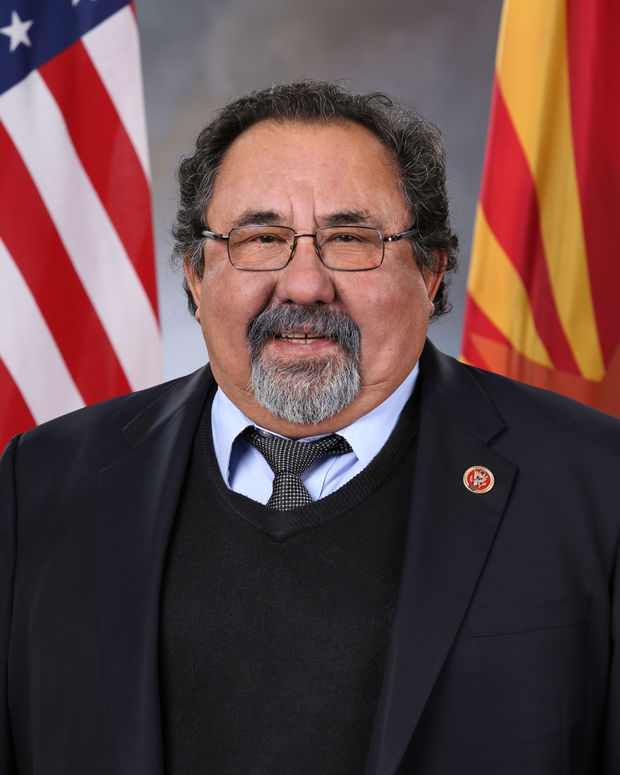
Grijalva

By Brian Flagg,

Our U.S. Congressman, Raul Grijalva, is standing tall in his opposition to the biggest trade deal of the 21st century. It is called the Trans-Pacific Partnership, or TPP.

If this aint pure unadulterated evil, I don’t know what is.

Barbie Urias and I attended a packed Grijalva-organized town hall last Saturday on this subject. There was a very informative panel discussion that included Rebekah Friend, President of the State AFL-CIO, Sandy Bahr from the Sierra Club and former State legislator Phil Lopes.

This pact seems to legalize multinational corporations’ ability to super-exploit, be it workers, the environment, seniors and even the concept of democracy itself.

Raul’s op-ed in today’s Star should be required reading.

Check it out at: http://tucson.com/news/opinion/column/guest/grijalva-trade-deal-bad-for-seniors-workers-alike/article_e66aed4d-8da6-577d-8005-6ac6426d44f7.html

____________

Por Brian Flagg,

Nuestro Congresista, Raúl Grijalva, se pone en alto con su oposición al mayor acuerdo comercial del siglo 21 que se llama la Asociación Trans-Pacífico.

Si esto no es l pura maldad sin adulteraciones, no sé que lo es.

El sábado pasado, Barbie Urias y yo atendimos un ayuntamiento sobre este tema. Hubo un dialogo muy informativo por parte del panel el cual incluía a Rebeka Friend, Presidenta de AFL-CIO del Estado, Sandy Bahr del Club Sierra, y al ex legislador Estatal Phil Lopes.

Este pacto parece legalizar la habilidad de que corporaciones multinacionales puedan súper-explotar, ya sea a los trabajadores, el medio ambiente, los ancianos, e incluso el mismo concepto de la democracia.

Le editorial de Raúl en el diario Star debería ser una lectura requerida para todos.

Aquí está la traducción del editorial:

Por el Rep. Raúl M. Grijalva Especial para Arizona Daily Star,

Tan pronto como en esta semana, la Cámara de Representantes votará sobre si ellos mismos deben dejar de lado las negociaciones sobre el mayor acuerdo comercial del siglo 21.

Ese acuerdo – la Asociación Trans – Pacífico, o TPP – une a nuestra economía y el destino de nuestros trabajadores con las de otros 11 países , muchos de los cuales no tienen los mismos altos estándares de trabajo que nosotros , y algunos de los cuales son conocidos por violaciones de los derechos humanos y la manipulación del dinero.

El obligar a los trabajadores estadounidenses a competir con trabajadores en Vietnam, los que ganan menos de 60 centavos por hora tendrá un resultado predecible: Los trabajos se externalizaran y se perderán los medios de vida en el país.

La próxima votación incluye una disposición denomina Asistencia para el Ajuste del Comercio, o TAA, que proporciona asistencia muy necesaria a los trabajadores que pierdan sus empleos debido a los acuerdos comerciales. El hecho de que la TAA sea necesaria es una admisión de que este acuerdo comercial es malo para nuestros trabajadores. Los defensores de la Alianza Trans -Pacífico la podrían estar vendiendo como una ganancia económica, pero lo que están haciendo es sentando las bases para que se destruyan los trabajos locales.

Y aquí viene lo bueno: los republicanos quieren pagar por TAA recortando 700 millones de dólares de Medicare. Las personas mayores no deberían tener que pagar el precio de malos acuerdos comerciales. Tampoco los trabajadores estadunidenses.

Pregúntese esto: ¿Esta es la altura de nuestra democracia? ¿Es el acto de que el Congreso vote para justificarse, y no tener que tomar decisiones difíciles, lo que pretendían nuestros fundadores? ¿O el mejor interés del pueblo estadounidense? ¿Las personas eligen a sus representantes cada dos años, sólo para que puedan venir a Washington a votar no votar? ¿O para enfrentar a las personas mayores vulnerables en contra de los trabajadores en extrema necesidad, como resultado de las políticas tóxicas?

Con todos estos aspectos negativos del TPP y el voto de Vía Rápida, vale la pena preguntarse, ¿quién gana?

Las corporaciones multinacionales ganan. Este acuerdo será una gran ayuda para las grandes empresas, la creación de amplias oportunidades para explotar la mano de obra barata en todo el Pacífico.

Las empresas también tendrán la facultad de impugnar leyes en países extranjeros que crean que infringen sus márgenes de beneficios. Eso significa que las empresas en el extranjero podrán desafiar protecciones fundamentales como la Ley de Aire Limpio, la Ley de Agua Limpia, y cualquier otra que proteja la vida, la ley de conservación del medio ambiente que se interpone entre sus sucias manos y sus objetivos finales.

Agrega las amenazas planteadas por la armonización de nuestras protecciones ambientales y de salud con otras 11 naciones que no mantienen los mismos estándares que hacemos, y tienes un desastre ambiental inminente que debe detenerse.

Si este es el libre comercio, entonces no necesitamos de libre comercio – necesitamos un comercio justo.

Debemos utilizar nuestras influencias para sacar a los trabajadores extranjeros de la pobreza – no permitir que sus regímenes arrastren a nuestros trabajadores a su nivel. Deberíamos estar invirtiendo en fondo fiduciario de Medicare para que pueda continuar sirviendo a los 50 millones de personas mayores y contando, que confían en él todos los días. En cambio, estamos robando para ayudar a aliviar la cifra de un acuerdo comercial que destruirá los trabajos.

La gente del Tercer Distrito del Congreso de Arizona me eligió, y creo que ellos esperan que vote. Creo que ellos no esperan que yo me ausente en decisiones difíciles, si no que exija y sea su voz.

Es por eso que me opongo a acuerdos comerciales ” Seguimiento rápido ” que son malos para América. Mi oposición no se trata de una falta de lealtad al presidente. He estado con él antes, y yo estaré con él de nuevo. Solo que no en el TPP.

Se trata de la lealtad a las personas que votaron por mí. Confiaron en mí para protegerlos de las leyes políticas como la Alianza Trans – Pacífico. No voy a defraudarlos.


Atención: Miembros del Sindicato de Pasajeros

TBRU Logo


Atención: miembros del sindicato de pasajeros

No habrá junta general este miércoles

POR FAVOR de atender la reunión del concejo municipal el Martes, junio 9 a las 5:30 pm

Y/o

La junta del Transit Task Force el Lunes, junio 8, 4 pm, en el edificio de la Ciudad/condado, 201 N. Stone ave., 6to piso.

(Ver previa entrada en el blog para más detalles)